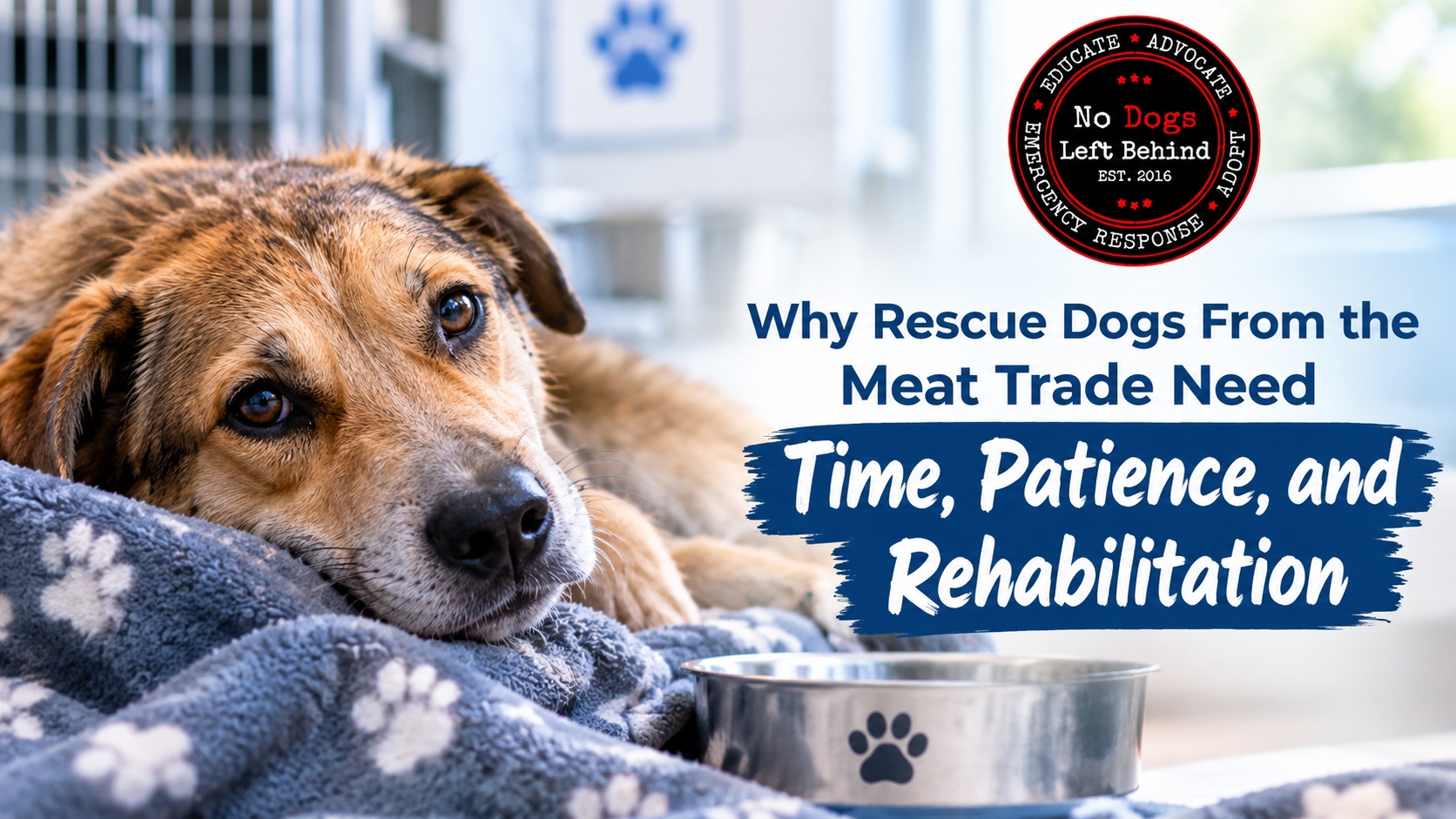
Rescuing a dog from the meat trade is only the beginning of the journey.
For many survivors, reaching safety does not immediately erase the fear, uncertainty, or physical challenges they have experienced. After rescue, dogs may need veterinary care, rehabilitation, socialization, and time to understand that their lives have changed.
At No Dogs Left Behind, rescue is part of a longer process that can continue through medical treatment, rehabilitation, and preparation for adoption. The goal is to help rescued dogs move from dangerous circumstances toward a safe and loving future.
For people learning about dog rescue or considering adopting a survivor, understanding why rehabilitation takes time can provide a clearer picture of what these dogs need.
When a dog is removed from a dangerous situation, the immediate priority is safety.
Dogs rescued from the meat trade may come from trafficking situations, slaughter trucks, wet markets, illegal holding facilities, or slaughterhouses. Rescue operations can give these animals the opportunity to begin a completely different life.
But the transition does not happen overnight.
A dog that has spent time in a stressful environment may need time to understand that it is finally safe.
This is why rehabilitation is such an important part of the rescue journey.
Some rescued dogs require medical attention after reaching safety.
Their individual needs can vary depending on their condition and circumstances. Veterinary care may be needed to address immediate concerns and support recovery.
Medical care can be only one part of the process.
A dog may become physically healthier while still remaining cautious, nervous, or uncertain around people and unfamiliar surroundings.
Recovery therefore needs to consider the whole dog, including physical and emotional adjustment.
Patience is one of the most important things a rescued dog can receive.
A dog cannot be expected to understand its new life immediately.
It may take time to become comfortable with:
Something that seems completely ordinary to a person may be unfamiliar to a dog that has spent much of its life in difficult conditions.
Giving the dog time allows it to discover these experiences at its own pace.
Trust is not something that can be forced.
Some rescued dogs may approach people quickly, while others may remain cautious. Each dog has its own personality and history.
Caregivers can help by creating a predictable environment and allowing the dog to experience positive interactions without pressure.
Simple moments can become meaningful signs of progress.
A dog may begin by watching people from a distance. Later, it may approach voluntarily. Eventually, it may seek affection, relax nearby, or become excited when a familiar caregiver enters the room.
These small changes can represent important steps in rehabilitation.
Rehabilitation is not simply about teaching a dog to interact with people.
It can involve helping the dog become comfortable with everyday life.
A rescued dog may need to learn that:
The process is different for every dog.
Some survivors may progress quickly, while others may need much longer periods of patient care.
A calm environment can make rehabilitation easier.
Caregivers can provide a consistent place for the dog to rest, regular feeding routines, access to fresh water, and opportunities for quiet time.
The dog should have space to move away from situations that feel overwhelming.
This does not mean avoiding all new experiences.
Instead, it means introducing changes gradually and allowing the dog to become comfortable before adding another challenge.
Predictability can help a rescued dog understand its new environment.
Regular meal times, rest periods, walks, and interactions can create a routine that the dog begins to recognize.
Over time, the dog may learn what to expect from its caregivers.
This can reduce uncertainty and create opportunities for confidence to grow.
A routine also gives caregivers a better way to observe changes in the dog’s behavior and identify areas where additional support may be needed.
Rehabilitation does not always happen through dramatic changes.
Sometimes progress appears in very small ways.
A frightened dog may finally sleep comfortably.
A cautious dog may approach a caregiver.
A dog that previously avoided certain surroundings may begin exploring.
Another dog may discover a toy and begin playing for the first time.
These moments can be easy to overlook, but they can represent important parts of the rehabilitation journey.
The process is about helping the dog become comfortable enough to experience life beyond survival.
Consistency can help create a sense of security.
When caregivers provide reliable food, shelter, medical attention, and patient interaction, dogs have opportunities to learn that their circumstances have changed.
Consistency is especially important when a dog is still learning how to trust people.
Caregivers should avoid expecting every dog to respond in exactly the same way.
Some dogs may want attention immediately. Others may need distance before they become comfortable.
Understanding those differences is part of responsible rehabilitation.
A rescue dog may need time to recover before becoming ready for adoption.
This can include continued medical care, socialization, observation, and support based on the dog’s individual needs.
The purpose is not to make every dog behave in exactly the same way.
Instead, rehabilitation can help the dog become better prepared for life in a home and help caregivers understand what kind of environment may be appropriate.
People considering adoption can review the No Dogs Left Behind adoption information to learn more about the adoption process.
Moving from a rescue environment into a home can be another major transition.
A dog may need to become familiar with household routines, family members, other pets, and new surroundings.
This is why patience remains important even after adoption.
The rehabilitation journey does not necessarily end the moment a dog enters a forever home.
For some survivors, their new family becomes an important part of continuing to build confidence.
People who adopt a rescued dog should understand that the dog may need time to adjust.
Expectations can have a major impact on the experience.
Rather than expecting the dog to immediately behave like a fully settled household pet, adopters can focus on creating a safe and predictable environment.
Important qualities include:
A successful relationship develops over time.
For additional information about the transition into a new home, what happens after adopting a rescue dog from China provides another perspective on the adoption journey.
One of the most meaningful parts of rehabilitation is seeing a rescued dog experience ordinary life.
A dog that once faced fear and uncertainty may eventually enjoy sleeping in a comfortable bed, walking outside, playing with a toy, or resting beside its family.
These experiences may seem simple.
For a survivor, they can represent an entirely new chapter.
Rehabilitation gives dogs opportunities to discover that life can include safety, companionship, routine, and care.
Helping a rescued dog recover is rarely the work of one person.
It can involve:
Each person can contribute to a different stage of the dog’s journey.
From emergency rescue and medical treatment to rehabilitation and adoption, the process requires continued commitment.
Rehabilitation helps individual dogs, but rescue organizations also work toward broader change.
Supporting efforts that address animal cruelty can help raise awareness about the conditions that make rescue necessary in the first place.
People can learn more about how to help stop the dog meat trade and explore different ways to support animal welfare efforts.
For No Dogs Left Behind, rescue, rehabilitation, adoption, and broader animal welfare work are connected parts of its mission.
There is no single rehabilitation timeline that applies to every rescued dog.
One dog may begin trusting people quickly.
Another may need considerably more time.
A third may appear confident in one environment but become nervous in another.
These differences are normal parts of working with individual rescue dogs.
The important thing is to recognize progress without comparing one dog to another.
Rehabilitation should meet the needs of the individual animal.
Time gives a rescued dog opportunities to experience consistency.
With time, a dog can begin to recognize familiar caregivers, understand daily routines, explore new surroundings, and develop confidence.
Patience allows these experiences to happen without unnecessary pressure.
For a dog coming from a difficult past, simply having time to rest and feel safe can be an important part of recovery.
The ultimate goal of rehabilitation is not simply to help a dog become comfortable around people.
It is to give that dog an opportunity to become part of a family.
A rescued dog can move through several stages:
Rescue → Medical Care → Rehabilitation → Trust → Adoption → Forever Home
Every stage matters.
The journey may not always be quick or predictable, but each step can bring the dog closer to a safe and loving life.
Rescue dogs from the meat trade need more than a way out of an unsafe environment.
They need time to recover, patience from the people caring for them, and rehabilitation that recognizes their individual needs.
Some survivors may require medical care. Others may need help learning to trust people or become comfortable with everyday experiences. Many need a combination of physical care, emotional support, routine, and time.
The journey continues long after a dog reaches safety.
With dedicated caregivers, veterinarians, volunteers, adopters, and supporters, rescued dogs can have the opportunity to move beyond survival and begin experiencing the safety and companionship of a forever home.
Many rescued dogs have experienced difficult and stressful conditions. Rehabilitation gives them time and support to recover, build confidence, adjust to new surroundings, and prepare for life in a home.
There is no single timeline. Every dog has different needs, experiences, health conditions, and personalities. Some dogs may adjust relatively quickly, while others require a longer period of patient care.
Many rescued dogs can gradually become more comfortable with people when they receive consistent care, patience, and positive interactions. The pace of progress varies from dog to dog.
It can. Entering a forever home may introduce new people, routines, surroundings, and experiences. Some dogs continue building confidence and adjusting to everyday life after adoption.
Adopters can provide a safe environment, consistent routines, patience, appropriate veterinary care, and respect for the dog’s individual boundaries. Allowing the dog to adjust at its own pace can support the transition into a new home.

